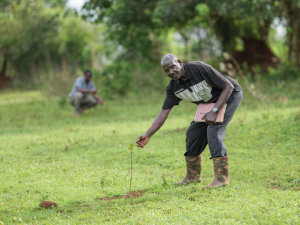
On his 20-acre farm, Steven Rwankenge, from Kyenjojo district in Uganda, has planted more than 2,400 trees, practicing a mix of silvopasture planting, boundary planting, woodlots, and agroforestry perennials. His goal is simple but profound — to restore the environment that once thrived around his village.
“Our climate has changed because we cut down too many trees,” Steven says. “If everyone could go back to planting trees, we would have a better climate.”
Steven remembers a different landscape from his childhood. The hills around his village were once lush and green, and the rains came reliably with every season. “But now,” he reflects, “the climate is unpredictable.”
Motivated by this change, Steven began replanting trees on parts of his land that had become bare. His efforts received a boost when the Evergreening Global Alliance’s Restore Africa Programme partnered with him, helping him expand his restoration work.
A retired teacher trainer who served for 35 years and has been retired for 25, Steven has carried his passion for teaching into his environmental work — inspiring not only his community but also his own children to continue the mission of restoration. “Even when I am gone,” he says, “I want them to keep planting trees.”
Every day, Steven can be found tending to his coffee plants, cattle, and a growing forest of indigenous tree species. His dedication reflects a belief he holds deeply: “As we continue to live, so must we continue to grow trees.”
Thanks to champions like Steven, CRS Uganda and the Restore Africa Programme have mobilised a national movement for reforestation. As of September 2025, more than 70,409 farmers have joined the effort, committing 147,012 hectares of land to restoration and planting over 6.5 million trees across the country.
Story by Lanyero Flavia
Photos by Kizito Mudambo